
8 E-commerce Platforms Worth Knowing in 2026
Choosing an e-commerce platform is an important decision. The platform you choose affects how your store is built, how it’s managed, what you can customize, and how easily you can scale as your business grows.
There isn’t one platform that’s right for everyone. Some are built for simplicity, while others offer more flexibility and control.
Here are some of the e-commerce platforms worth knowing in 2026.
1. Shopify
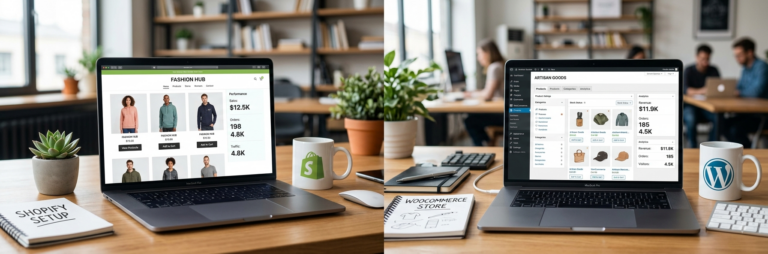
Shopify is one of the most popular e-commerce platforms and is built specifically for online stores.
It’s a hosted solution, which means hosting, security and much of the technical infrastructure are handled for you. It also offers a large ecosystem of themes, apps and integrations.
Best for: Businesses that want a flexible, e-commerce-focused platform without managing the underlying infrastructure themselves.
2. WooCommerce
WooCommerce is an open-source e-commerce platform built on WordPress.
It gives you a high level of control over your website, including hosting, design, functionality and integrations. This flexibility can be a major advantage, although it also means more responsibility for maintenance and security.
Best for: Businesses already using WordPress or those looking for more control and customization.
3. BigCommerce
BigCommerce is a hosted e-commerce platform designed with growing and larger businesses in mind.
It offers built-in features for areas such as product management, multi-channel selling, SEO and analytics, reducing the need to rely on additional apps for every feature.
Best for: Growing businesses that need a scalable platform with a strong set of built-in e-commerce features.
4. Wix eCommerce
Wix combines website building with e-commerce functionality.
Its visual editor makes it relatively easy to create and manage a store without extensive technical knowledge. It’s particularly suited to smaller businesses that want their website and online store in one place.
Best for: Small businesses, entrepreneurs and beginners who value simplicity and visual control.
5. Squarespace
Squarespace is known for its design-focused templates and polished visual experience.
Its e-commerce tools make it possible to sell products while keeping a strong focus on branding and presentation.
Best for: Creatives, personal brands and smaller businesses where design and visual identity are a major part of the website.
6. Adobe Commerce
Formerly known as Magento, Adobe Commerce is a powerful e-commerce solution aimed primarily at larger and more complex businesses.
It offers extensive customization and flexibility, but it also requires considerably more technical expertise and resources than platforms such as Shopify or Wix.
Best for: Larger businesses and enterprises with complex e-commerce requirements and development resources.
7. OpenCart
OpenCart is an open-source e-commerce platform that gives businesses control over their store and its underlying setup.
It supports a wide range of extensions and integrations, but setting up and maintaining the platform generally requires more technical involvement.
Best for: Businesses and developers looking for an open-source solution with flexibility and control.
8. Ecwid
Ecwid takes a slightly different approach. Instead of requiring you to build an entirely new website, it can be added to an existing website to introduce e-commerce functionality.
This makes it useful for businesses that already have a website and simply want to start selling online.
Best for: Small businesses that want to add an online store to an existing website.
So, Which Platform Should You Choose?
The best e-commerce platform isn’t necessarily the one with the longest feature list.
Think about how much control you need, how technical your team is, how much maintenance you’re willing to handle, what your budget looks like, and where you expect your business to be in the next few years.
For some businesses, Shopify’s managed approach makes the most sense. For others, the flexibility of WooCommerce or another open-source platform may be more valuable.
The important thing is to choose a platform that works for your business today without creating unnecessary limitations tomorrow.
The right platform should support your business, not become another problem to manage.
more insights

Website Characterization: What to Define Before Building Your Website
Back to all insights Introduction Before you choose a platform, start designing pages, or write a single line of code, there is an important step

E-commerce Checklist
Back to all insights “` Ultimate E-commerce Checklist for Success & SEO Building and managing a successful e-commerce store involves more than adding products and
Shopify vs. WooCommerce: Which E-commerce Platform Is Right for Your Business?
Back to all insights Choosing an e-commerce platform is one of those decisions that can affect almost everything that comes after it. Your platform influences